90m
Read
22,000
Words
10
Chapters
AI & Society
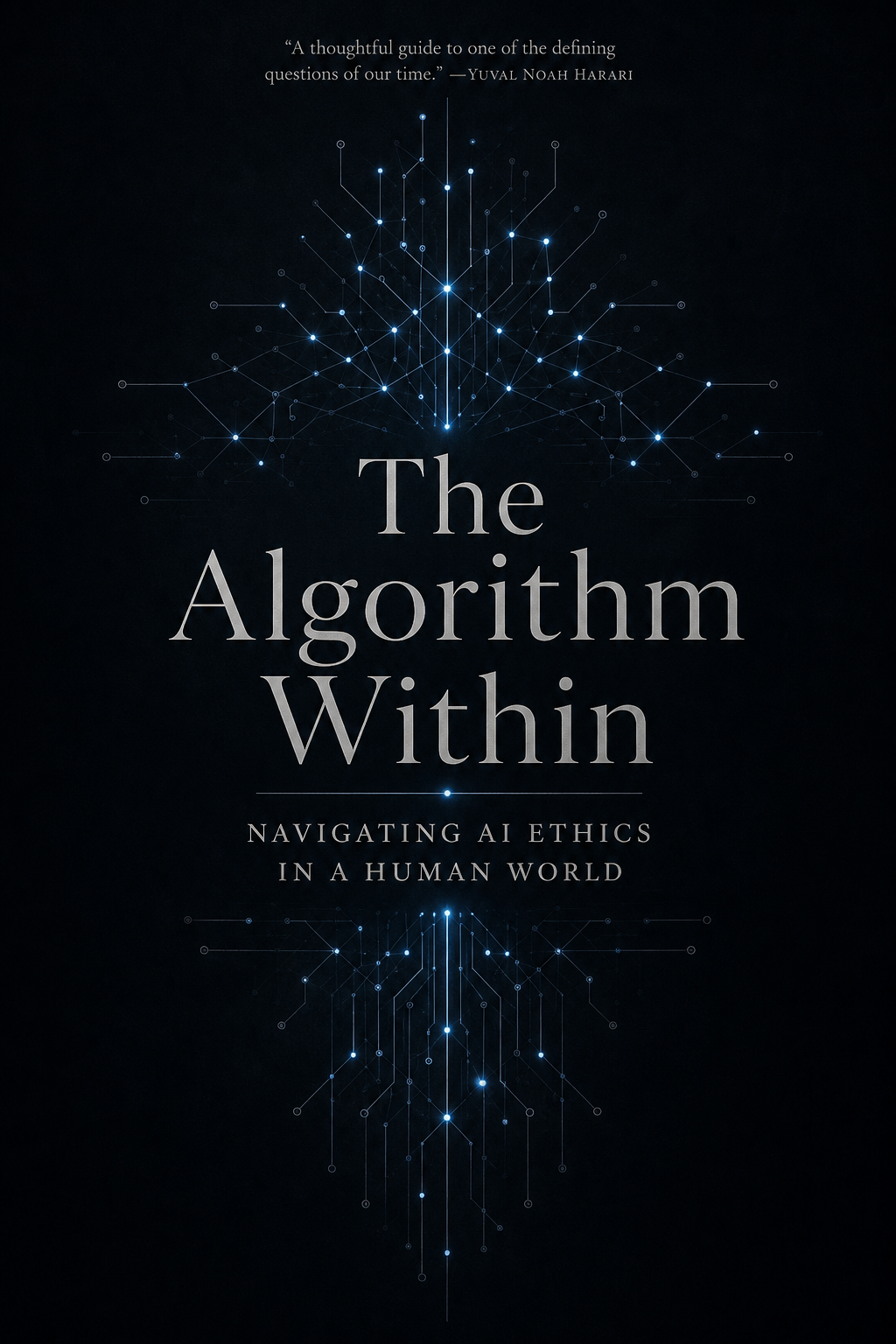
The Algorithm Within
Navigating AI Ethics in a Human World
Artificial intelligence no longer waits politely at the edge of our lives — it decides what we read, who gets hired, and increasingly, what we believe is true. But the urgent questions are not technical. They are moral, and they belong to all of us. The Algorithm Within is a field guide for thinking clearly about machines that think. In under two hours you will learn how modern AI systems actually make decisions, where bias hides inside them, and why 'the computer said so' is the most dangerous sentence of our decade. This is not a doomsday book, and it is not a sales pitch. It is a calm, sharply argued invitation to become a more literate citizen of an automated age — before the defaults are chosen for you.
A full-length business book takes ~5 hours. This one respects your time.
What’s inside
Every chapter is engineered to be read in one sitting.
A focused 8-minute chapter. You will finish it understanding not just what to do, but why it works — and the single highest-leverage move to make first.
Read the first pages, free
There is a comfortable story we tell ourselves about technology: that it is neutral, that a tool is only as good or bad as the hand that wields it. A hammer builds a house or breaks a window; the hammer does not care. For most of human history this was close enough to true. It is no longer true at all.
Modern artificial intelligence does not sit inertly, waiting for a human hand. It observes, predicts, ranks, and recommends millions of times per second, and every one of those actions embeds a judgment about what matters. When a lending model decides your interest rate, it is not merely calculating — it is enacting a theory about who deserves trust. When a feed decides what you see next, it is making a wager about what will hold your attention, and attention, as we will see, is rarely the same thing as truth.
The trouble is that these judgments arrive dressed in the costume of objectivity. A number feels neutral. A recommendation feels like a fact. And so we grant algorithms a kind of authority we would never extend to a stranger making the same claims. 'The computer said so' has quietly become one of the most powerful sentences in modern life, and also one of the most dangerous, because it ends conversations that ought to be beginning.
This short book has one goal: to help you think clearly about machines that think. Not to make you an engineer — the math is not the point — but to make you fluent in the questions that matter. How does this system decide? Whose data taught it? Who benefits when it is right, and who pays when it is wrong? Can a human overrule it, and does anyone bother to try?
I have spent years watching brilliant, well-meaning teams build systems that produced outcomes none of them intended. Not through malice, but through a thousand small defaults that no one paused to question. The bias was not in anyone’s heart. It was in the training data, the loss function, the quiet decision to optimize for clicks because clicks were easy to measure and dignity was not.
That is the uncomfortable truth at the center of AI ethics: most harm is not chosen. It is inherited, automated, and scaled. Which means the remedy is not outrage but literacy — the ability to look at a confident machine and ask the unfashionable question, 'Says who?'
Over the next nine chapters we will build that literacy together, quickly and without jargon. We will open the black box just far enough to see how decisions are really made. We will learn to spot bias not as a slogan but as a measurable, fixable property of a system. And we will end with something practical: a citizen’s toolkit for living, working, and voting in a world where the most consequential decisions are increasingly made by code.
You do not need permission to think about this, and you do not have much time to wait. The defaults are being written right now, in rooms you will never enter, by people who would genuinely welcome your scrutiny. Let’s begin.
Keep reading — unlock the full micro-book instantly.
Reader reviews
214 reviews
All reviews · 4
Exactly what I needed
Read it on a single flight and walked off with three things I actually changed the next day. No filler, no padding — just signal.
— Marcus T.
Finally, a book that respects my time
I never finish long non-fiction. Finished this in one sitting and immediately recommended it to two friends.
— Priya S.
Sharp and practical
Loses nothing by being short. A couple of sections I wanted more depth on, but the core argument lands hard.
— David L.
Punches way above its length
More useful than the 400-page bestseller I gave up on last month. Beautifully written too.
— Elena R.
Readers also bought
Mental Resilience
Unbreakable Mind
Building Mental Resilience That Lasts
Science of Living Longer
The Longevity Code
The New Science of Living Longer
Emotional Intelligence
The Empathy Edge
Emotional Intelligence in the Age of AI
Biohacking & Longevity
Biohack Your Biology
The Science of Optimizing Your Body