72m
Read
17,500
Words
6
Chapters
Fitness & Movement
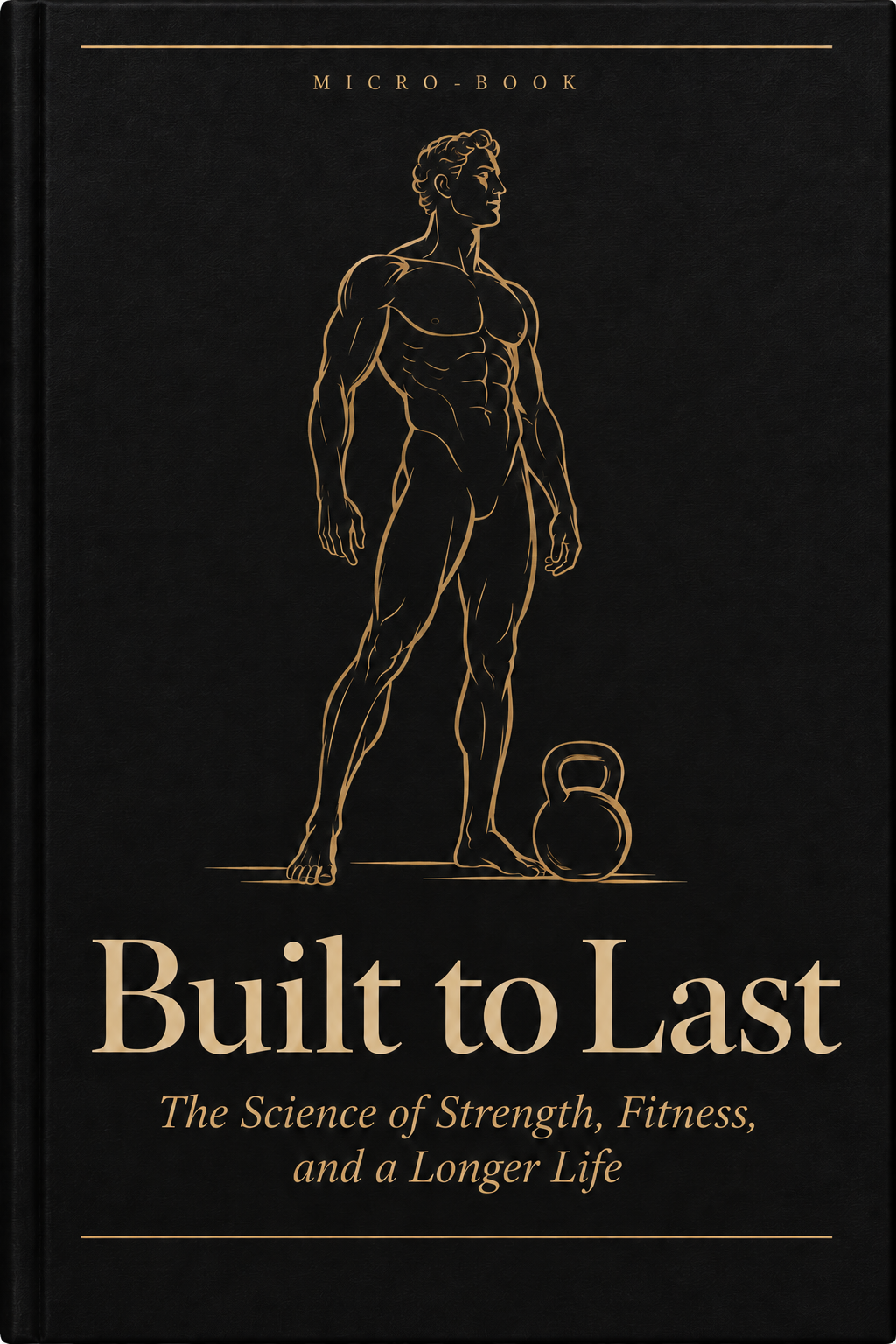
Research-backedBuilt to Last
The Science of Strength, Fitness, and a Longer Life
If there were a single intervention that lowered your risk of dying from nearly every major cause, improved your mood, protected your brain, and kept you independent into old age, it would be the most valuable product on earth. It exists. It is exercise, and almost no one takes the full dose. Built to Last is an AI-assisted compilation, written and edited with large language models and grounded in current, peer-reviewed research. It cuts through fitness culture to the two things the evidence most strongly rewards: cardiorespiratory fitness and muscular strength. In about 72 minutes you will learn why fitness is one of the strongest predictors of how long you live, why strength training is non-negotiable as you age, and how to train for a longer, more capable life without living in a gym. Every study cited is real and published.
An AI-assisted compilation, written and edited with large language models and grounded in current, peer-reviewed research. Every study cited is real and published — where the evidence is still emerging, the text says so.
A full-length business book takes ~5 hours. This one respects your time.
What’s inside
Every chapter is engineered to be read in one sitting.
A focused 11-minute chapter. You will finish it understanding not just what to do, but why it works — and the single highest-leverage move to make first.
Read the first pages, free
Imagine a drug that reduced your risk of death from heart disease, cancer, and almost everything else; that lifted depression, sharpened memory, strengthened bones, and kept you walking under your own power at eighty. Imagine it had almost no side effects and cost nothing. Every doctor on earth would prescribe it, and most of us would still not take it.
That drug is physical fitness, and the evidence for it is not soft. In 2018, a study by Kyle Mandsager and colleagues in JAMA Network Open followed more than 122,000 people who had performed a treadmill fitness test. The finding was stark: higher cardiorespiratory fitness was associated with dramatically lower mortality, and — remarkably — there was no observed ceiling. The fittest group lived longest, and being extremely unfit carried a risk the authors compared to that of serious chronic disease. Fitness was not just correlated with health. It was one of the strongest predictors of survival the researchers had.
Most people hear 'fitness' and think only of cardio — running, cycling, the breathless pursuit of a stronger heart. That engine matters enormously. But there is a second engine that gets ignored until it is almost too late: muscular strength. A 2022 meta-analysis by Haruki Momma and colleagues in the British Journal of Sports Medicine pooled data across large populations and found that muscle-strengthening activity — as little as thirty to sixty minutes per week — was associated with meaningfully lower risk of death from all causes, cardiovascular disease, and cancer, independent of cardio. Strength is not vanity. It is, increasingly, understood as a pillar of longevity.
This matters most as we age. From our thirties onward we lose muscle quietly, year after year, unless we actively push back. That slow erosion is what eventually turns a stumble into a broken hip, and a broken hip, in later life, into a cascade. The single most reliable way to stay independent is to arrive at old age with strength to spare — and the only way to do that is to build it now.
This book is about those two engines, aerobic and muscular, and how to run both without reorganizing your life around a gym. We will look at what the research actually rewards, how much is enough, and how to build training you will still be doing in a decade — because the dose that works is the one you take. Let’s build a body that lasts.
Keep reading — unlock the full micro-book instantly.
The research behind this book
This title is an AI-assisted compilation, written and edited with the help of large language models and grounded in current, peer-reviewed research. Every study cited below is real and published. Where the evidence is still emerging, the text says so rather than overstating the case.
- 01Mandsager, K., Harb, S., Cremer, P., et al. (2018). Association of Cardiorespiratory Fitness With Long-term Mortality Among Adults Undergoing Exercise Treadmill Testing. JAMA Network Open, 1(6), e183605.
- 02Momma, H., Kawakami, R., Honda, T., & Sawada, S. S. (2022). Muscle-strengthening activities are associated with lower risk and mortality in major non-communicable diseases: a systematic review and meta-analysis. British Journal of Sports Medicine, 56(13), 755–763.
Reader reviews
58 reviews
All reviews · 5
Exactly what I needed
Read it on a single flight and walked off with three things I actually changed the next day. No filler, no padding — just signal.
— Marcus T.
Finally, a book that respects my time
I never finish long non-fiction. Finished this in one sitting and immediately recommended it to two friends.
— Priya S.
Sharp and practical
Loses nothing by being short. A couple of sections I wanted more depth on, but the core argument lands hard.
— David L.
Punches way above its length
More useful than the 400-page bestseller I gave up on last month. Beautifully written too.
— Elena R.
Great value
For the price and the time, this is a steal. Clear, well-argued, and I actually remember what I read.
— James K.
Readers also bought
Mental Resilience
Unbreakable Mind
Building Mental Resilience That Lasts
Sleep & Recovery
Research-backedThe Sleeping Brain
How Rest Rebuilds Memory, Mood, and Mind
AI & Society
The Algorithm Within
Navigating AI Ethics in a Human World
Science of Living Longer
The Longevity Code
The New Science of Living Longer