70m
Read
17,000
Words
6
Chapters
Sleep & Recovery
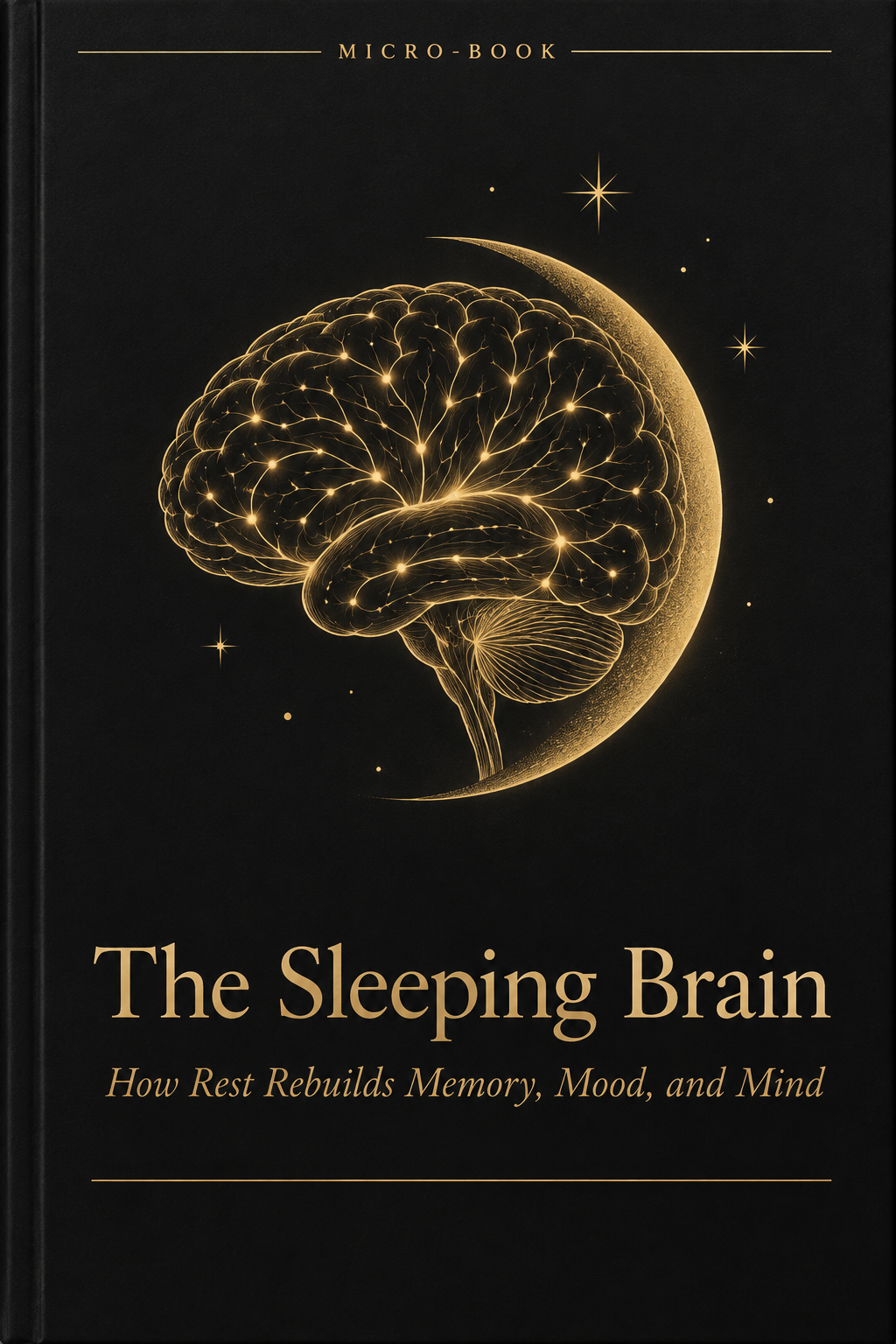
Research-backedThe Sleeping Brain
How Rest Rebuilds Memory, Mood, and Mind
We treat sleep as the thing we cut when life gets busy — the first expense trimmed, the last priority defended. The science says we have it exactly backwards: sleep is not downtime. It is when the brain does some of its most important work. The Sleeping Brain is an AI-assisted compilation, written and edited with large language models and grounded in current, peer-reviewed research. It distills what sleep scientists actually know — how deep sleep flushes metabolic waste from the brain, how dreaming sleep consolidates memory and regulates emotion — into one focused, honest read. In about 70 minutes you will understand why a bad night blunts learning, darkens mood, and clouds judgment, and what the evidence says you can realistically do about it. Every study cited is real and published. Where the science is still emerging, we say so.
An AI-assisted compilation, written and edited with large language models and grounded in current, peer-reviewed research. Every study cited is real and published — where the evidence is still emerging, the text says so.
A full-length business book takes ~5 hours. This one respects your time.
What’s inside
Every chapter is engineered to be read in one sitting.
A focused 11-minute chapter. You will finish it understanding not just what to do, but why it works — and the single highest-leverage move to make first.
Read the first pages, free
There is a quiet arrogance in how modern life treats sleep. We speak of it as a gap — the inconvenient hours between the things that matter — and we wear our ability to go without it as a badge. The founder who sleeps four hours. The student pulling an all-nighter. The parent running on fumes and caffeine. Sleep, in this story, is the enemy of ambition.
The science tells a different and far more interesting story. Sleep is not the absence of activity. It is a distinct, highly organized state in which the brain runs maintenance that cannot happen while you are awake — clearing waste, filing memories, and recalibrating emotion. Skip it, and you are not simply tired. You are skipping the repair.
Consider what happens to the physical brain at night. In 2013, researchers led by Lulu Xie, publishing in Science, discovered that during sleep the spaces between brain cells widen dramatically, letting cerebrospinal fluid flush through and carry away metabolic byproducts that accumulate during waking hours — including the proteins implicated in neurodegeneration. The brain, in effect, runs a rinse cycle, and it runs it best when you are deeply asleep. You cannot buy that. You can only sleep it.
Then there is memory. Decades of work, synthesized in Matthew Walker and Robert Stickgold’s review of sleep, memory, and plasticity, show that sleep does not merely rest the mind — it actively consolidates what you learned that day, moving fragile new memories into durable storage and weaving them into what you already know. A night of good sleep after learning is not a luxury. It is part of the learning.
And sleep governs mood. Pull a single all-nighter and the brain’s emotional alarm system becomes measurably more reactive, while the rational brain that normally restrains it goes quiet. This is why everything feels worse at 3 a.m., and why a run of bad nights can tip ordinary stress into something heavier.
This short book is about taking that seriously. We will look at what sleep actually does, chapter by chapter, and then at what the evidence says you can do to get more of the good kind. No miracle gadgets, no perfect routine — just the working biology of rest, and the handful of changes that reliably move the needle. Let’s begin where the day really ends.
Keep reading — unlock the full micro-book instantly.
The research behind this book
This title is an AI-assisted compilation, written and edited with the help of large language models and grounded in current, peer-reviewed research. Every study cited below is real and published. Where the evidence is still emerging, the text says so rather than overstating the case.
- 01Xie, L., Kang, H., Xu, Q., et al. (2013). Sleep Drives Metabolite Clearance from the Adult Brain. Science, 342(6156), 373–377.
- 02Walker, M. P., & Stickgold, R. (2006). Sleep, Memory, and Plasticity. Annual Review of Psychology, 57, 139–166.
Reader reviews
64 reviews
All reviews · 4
Exactly what I needed
Read it on a single flight and walked off with three things I actually changed the next day. No filler, no padding — just signal.
— Marcus T.
Finally, a book that respects my time
I never finish long non-fiction. Finished this in one sitting and immediately recommended it to two friends.
— Priya S.
Sharp and practical
Loses nothing by being short. A couple of sections I wanted more depth on, but the core argument lands hard.
— David L.
Punches way above its length
More useful than the 400-page bestseller I gave up on last month. Beautifully written too.
— Elena R.
Readers also bought
Mental Resilience
Unbreakable Mind
Building Mental Resilience That Lasts
Fitness & Movement
Research-backedBuilt to Last
The Science of Strength, Fitness, and a Longer Life
Science of Living Longer
The Longevity Code
The New Science of Living Longer
AI & Society
The Algorithm Within
Navigating AI Ethics in a Human World