68m
Read
16,500
Words
6
Chapters
Focus & Attention
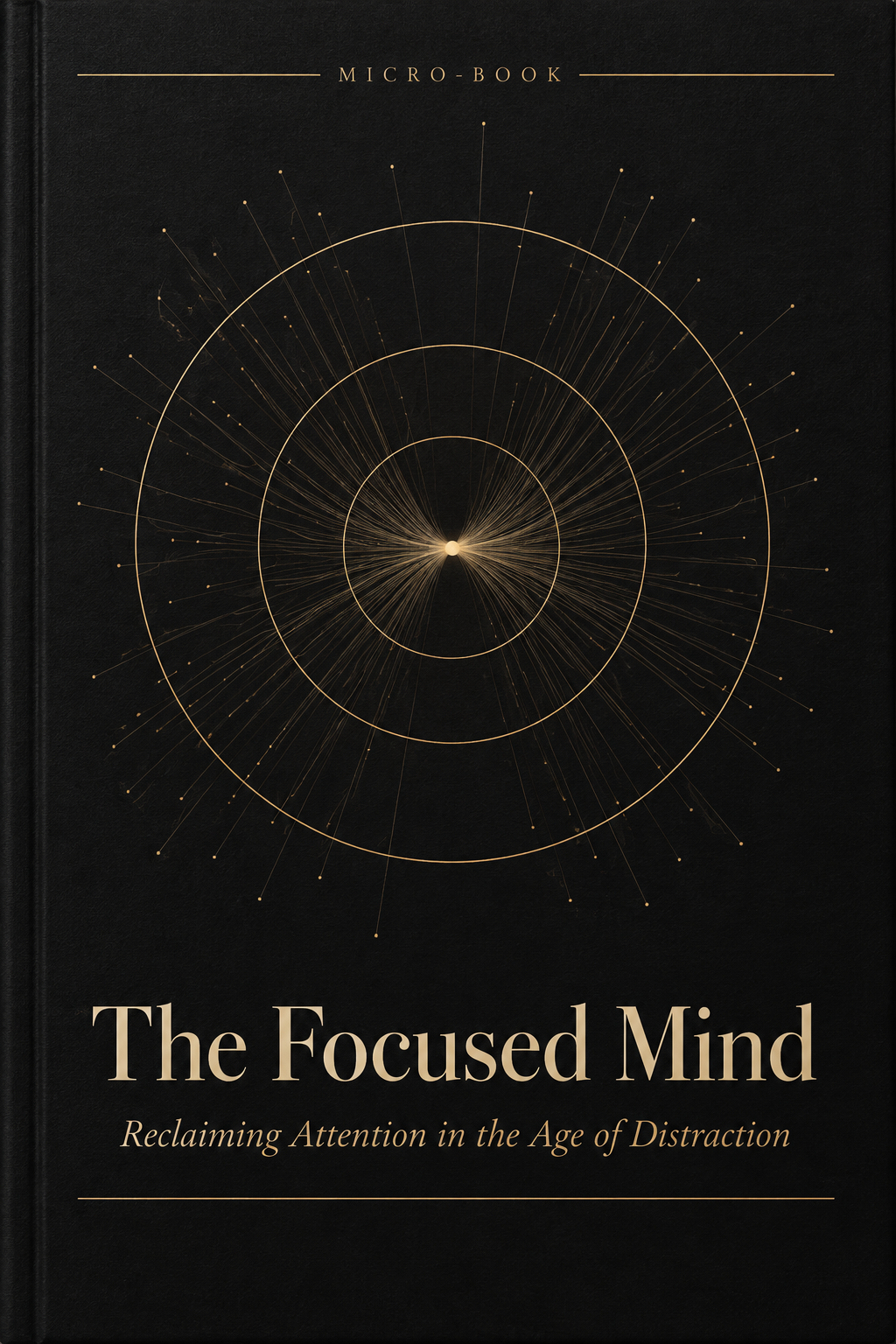
Research-backedThe Focused Mind
Reclaiming Attention in the Age of Distraction
Your attention is the most valuable thing you own, and it is under organized assault. Every app, feed, and notification is engineered by teams whose job is to capture it. No wonder focus feels harder than it used to. The Focused Mind is an AI-assisted compilation, written and edited with large language models and grounded in current, peer-reviewed research. It explains what attention actually is, what fragmenting it really costs, and how to rebuild the capacity for deep, sustained work. In about 68 minutes you will learn why multitasking is a myth, why switching tasks leaves a residue that quietly degrades everything you do next, and what the evidence says about reclaiming your concentration. Every study cited is real and published.
An AI-assisted compilation, written and edited with large language models and grounded in current, peer-reviewed research. Every study cited is real and published — where the evidence is still emerging, the text says so.
A full-length business book takes ~5 hours. This one respects your time.
What’s inside
Every chapter is engineered to be read in one sitting.
A focused 11-minute chapter. You will finish it understanding not just what to do, but why it works — and the single highest-leverage move to make first.
Read the first pages, free
Sit down to do one important thing, and notice what happens. Within minutes a thought surfaces — check the phone, glance at the inbox, see what just buzzed. You resist, or you don’t, and either way a small tax has been levied on your concentration. Do this a few hundred times a day, as most of us now do, and the cumulative cost is enormous. We are, collectively, losing the ability to pay sustained attention to anything, and we rarely stop to ask why.
Part of the answer is that we have been sold a flattering lie: that we can multitask, that a capable mind can run several streams at once. The research is unkind to this belief. In a landmark 2009 study in the Proceedings of the National Academy of Sciences, Eyal Ophir, Clifford Nass, and Anthony Wagner tested people who routinely juggled many media streams against those who did not. The expectation was that the heavy multitaskers would be better at filtering and switching. The opposite was true. The heavy multitaskers were more distractible, worse at ignoring irrelevant information, and worse at switching between tasks. Practice at dividing attention had not made them better at it. It had made them worse at focusing at all.
The deeper problem is what happens in the moment of switching. In research published that same year, Sophie Leroy described a phenomenon she called attention residue: when you move from one task to another, part of your mind stays stuck on the first, especially if it was left unfinished. You are physically working on task two while a portion of your cognitive capacity is still running task one in the background. The result is that neither gets your full mind. Every 'quick glance' at your phone mid-project leaves a residue that lingers long after you look away.
Now place that fragile system inside an economy explicitly designed to exploit it. The apps on your phone are not neutral tools; they are built by talented teams whose success is measured in captured attention. You are not weak-willed for losing to them. You are outgunned — unless you understand the game and change the rules.
That is what this book is for. We will look at what attention really is, what fragmenting it costs in hard experimental terms, and then — practically — how to rebuild the capacity for deep, undistracted work in a world engineered against it. The ability to focus is becoming rare, which is precisely what makes it valuable. Let’s reclaim it.
Keep reading — unlock the full micro-book instantly.
The research behind this book
This title is an AI-assisted compilation, written and edited with the help of large language models and grounded in current, peer-reviewed research. Every study cited below is real and published. Where the evidence is still emerging, the text says so rather than overstating the case.
- 01Ophir, E., Nass, C., & Wagner, A. D. (2009). Cognitive control in media multitaskers. Proceedings of the National Academy of Sciences, 106(37), 15583–15587.
- 02Leroy, S. (2009). Why is it so hard to do my work? The challenge of attention residue when switching between work tasks. Organizational Behavior and Human Decision Processes, 109(2), 168–181.
Reader reviews
71 reviews
All reviews · 5
Exactly what I needed
Read it on a single flight and walked off with three things I actually changed the next day. No filler, no padding — just signal.
— Marcus T.
Finally, a book that respects my time
I never finish long non-fiction. Finished this in one sitting and immediately recommended it to two friends.
— Priya S.
Sharp and practical
Loses nothing by being short. A couple of sections I wanted more depth on, but the core argument lands hard.
— David L.
Punches way above its length
More useful than the 400-page bestseller I gave up on last month. Beautifully written too.
— Elena R.
Great value
For the price and the time, this is a steal. Clear, well-argued, and I actually remember what I read.
— James K.
Readers also bought
Mental Resilience
Unbreakable Mind
Building Mental Resilience That Lasts
Sleep & Recovery
Research-backedThe Sleeping Brain
How Rest Rebuilds Memory, Mood, and Mind
AI & Society
The Algorithm Within
Navigating AI Ethics in a Human World
Science of Living Longer
The Longevity Code
The New Science of Living Longer