72m
Read
17,500
Words
6
Chapters
Gut & Microbiome
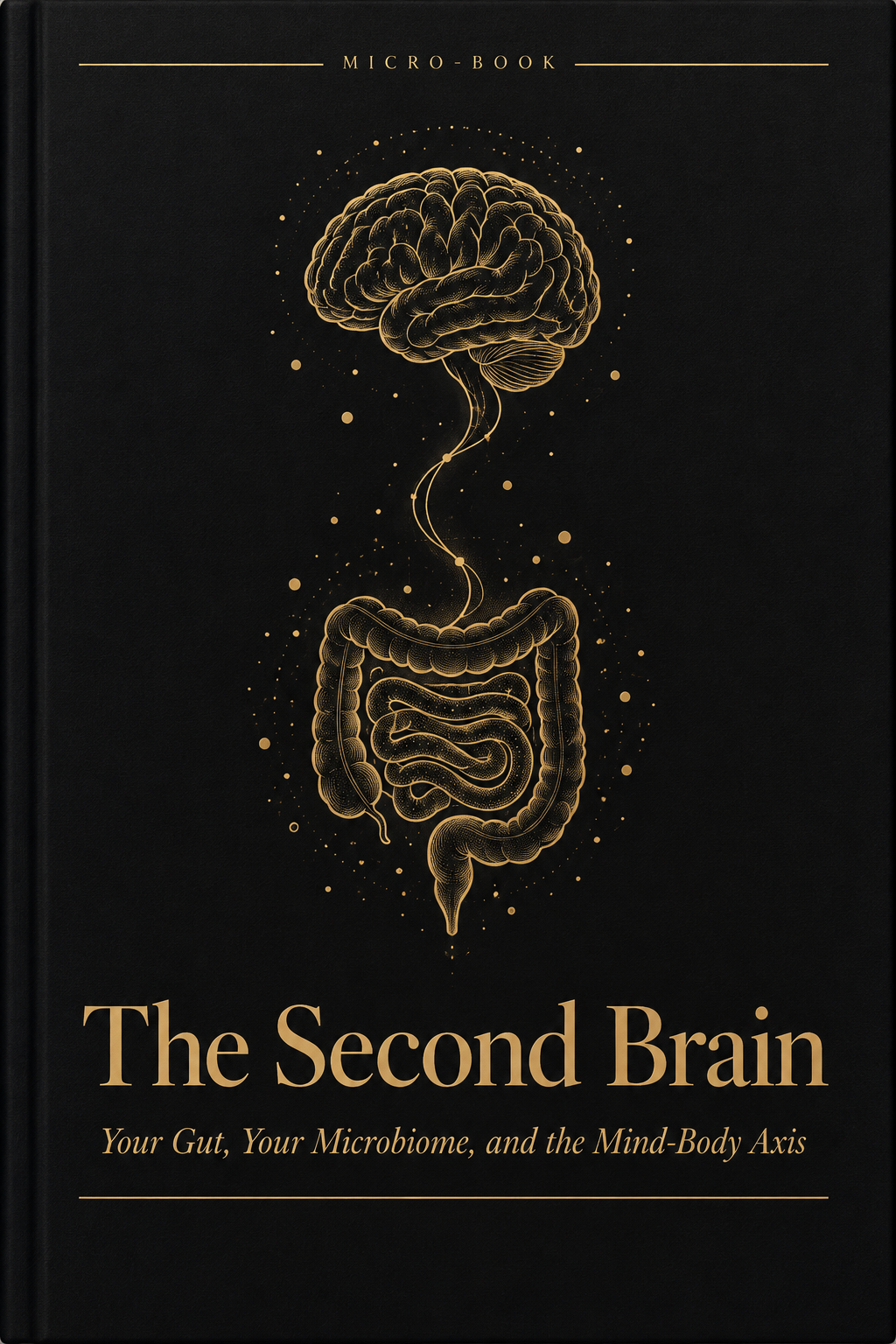
Research-backedThe Second Brain
Your Gut, Your Microbiome, and the Mind-Body Axis
You are not quite as alone in your body as you think. Trillions of microbes live in your gut, and a growing body of research suggests they help shape your immune system, your inflammation, and even your mood through a two-way line to the brain. The Second Brain is an AI-assisted compilation, written and edited with large language models and grounded in current, peer-reviewed research. It separates what is genuinely known about the microbiome from the marketing that has rushed in around it. In about 72 minutes you will learn how the gut talks to the brain, what the best human studies show about diet and the microbiome, and which changes are actually supported by evidence. Every study cited is real and published — and where the science is still young or hyped, we say so plainly.
An AI-assisted compilation, written and edited with large language models and grounded in current, peer-reviewed research. Every study cited is real and published — where the evidence is still emerging, the text says so.
A full-length business book takes ~5 hours. This one respects your time.
What’s inside
Every chapter is engineered to be read in one sitting.
A focused 11-minute chapter. You will finish it understanding not just what to do, but why it works — and the single highest-leverage move to make first.
Read the first pages, free
For most of medical history the gut was plumbing — a tube that processed food and was best not discussed. That picture is now being rewritten. Inside your intestines lives a dense, diverse community of microorganisms, collectively called the gut microbiome, and it turns out to be less like plumbing and more like an organ: active, responsive, and in constant conversation with the rest of you, including your brain.
That conversation is real, and it runs in both directions. The gut and the brain are linked by the vagus nerve, by the immune system, and by a stream of chemical messengers produced when gut bacteria ferment the fiber you eat. Scientists call this the microbiota-gut-brain axis, and while much of the strongest evidence still comes from animal studies, the human picture is filling in fast.
Some of the clearest signals come from short-chain fatty acids. In a 2019 review in Nature Reviews Gastroenterology & Hepatology, Boushra Dalile and colleagues examined how these molecules — acetate, propionate, and butyrate, made by bacteria breaking down dietary fiber — may act as messengers along the gut-brain axis, influencing inflammation and brain function. The authors are careful: the animal evidence is strong, the human evidence is still thin and sometimes inconsistent. That honesty is exactly why their work is worth trusting.
What about things you can actually do? Here one human study stands out. In 2021, Hannah Wastyk and colleagues, publishing in Cell, ran a randomized trial comparing two diets in healthy adults. The high-fermented-food group — yogurt, kefir, kimchi, and the like — showed increased microbial diversity and a measurable drop in markers of inflammation, including signaling proteins such as IL-6. Strikingly, a high-fiber diet did not raise diversity over the same ten weeks, likely because it takes time for the microbial community to adapt to digest it. Real food, real measurements, real nuance.
This book is a guided tour of that science, and an honest one. The microbiome is genuinely exciting, and it is also the subject of enormous overreach — supplements and tests promising far more than the evidence supports. We will walk the line carefully: what the gut-brain axis is, what it plausibly does, and the small set of dietary changes that the best human research actually backs. Let’s meet the ecosystem inside you.
Keep reading — unlock the full micro-book instantly.
The research behind this book
This title is an AI-assisted compilation, written and edited with the help of large language models and grounded in current, peer-reviewed research. Every study cited below is real and published. Where the evidence is still emerging, the text says so rather than overstating the case.
- 01Wastyk, H. C., Fragiadakis, G. K., Perelman, D., et al. (2021). Gut-microbiota-targeted diets modulate human immune status. Cell, 184(16), 4137–4153.
- 02Dalile, B., Van Oudenhove, L., Vervliet, B., & Verbeke, K. (2019). The role of short-chain fatty acids in microbiota–gut–brain communication. Nature Reviews Gastroenterology & Hepatology, 16, 461–478.
Reader reviews
49 reviews
All reviews · 4
Exactly what I needed
Read it on a single flight and walked off with three things I actually changed the next day. No filler, no padding — just signal.
— Marcus T.
Finally, a book that respects my time
I never finish long non-fiction. Finished this in one sitting and immediately recommended it to two friends.
— Priya S.
Sharp and practical
Loses nothing by being short. A couple of sections I wanted more depth on, but the core argument lands hard.
— David L.
Punches way above its length
More useful than the 400-page bestseller I gave up on last month. Beautifully written too.
— Elena R.
Readers also bought

Mental Resilience
Unbreakable Mind
Building Mental Resilience That Lasts
Sleep & Recovery
Research-backedThe Sleeping Brain
How Rest Rebuilds Memory, Mood, and Mind
AI & Society
The Algorithm Within
Navigating AI Ethics in a Human World
Science of Living Longer
The Longevity Code
The New Science of Living Longer